- Repointing & new flaunching
- Lead aprons, step flashings & back gutters
- Pots, cowls & bird guards
- Partial rebuilds & stack removal
- Drone check before any scaffold
Chimney repairs in Cambridge
A chimney is the most exposed part of a house: the highest point, open to wind, rain and frost on every side, and often the oldest brickwork on the roof. We carry out chimney repairs in Cambridge on everything from the prominent stacks of Victorian terraces to the plainer chimneys on post-war semis, fixing both the chimney itself and the roof around it. Cambridge City Council’s appraisal of the Mill Road area describes its terraces as having “prominent chimney stacks, often with decorative banding” and “varied clay pots”, and the De Freville streets in Chesterton are much the same. Those stacks are worth looking after properly.
Is your chimney causing the leak?
Very often, yes. Checkatrade notes that chimney flashing problems are a leading cause of roof leaks, and damp on a chimney breast usually starts at the top of the stack. Water gets in through eroded pointing, cracked flaunching, an open pot or a lifted flashing, then soaks down through the brickwork and shows up indoors, sometimes a floor below.
Not every damp chimney breast is a roof problem, though. Disused flues that were blocked off without ventilation can suffer from condensation, and decades of coal fires can leave salts in the plaster that draw moisture from the air. We check the outside first, usually by drone, so you don’t pay for work that won’t fix the stain. If the water is coming from somewhere else on the roof, our roof leak repairs page explains how we trace it.
Chimney repairs we carry out
Repointing
Pointing is the outer layer of mortar between the bricks, and it is the first thing to go. With about 40 days of air frost a year at the Met Office’s Cambridge station, water in the joints freezes, expands and breaks the mortar up. We rake out the loose joints and repoint them. On older, softer bricks, such as the pale Gault brick common across Cambridge, we match the existing mortar rather than using a hard cement mix that forces the weathering into the bricks themselves.
Flaunching
Flaunching is the mortar collar around the pots at the top of the stack. It holds the pots in place and sheds water off the top. When it cracks, water runs straight down inside the stack and the pots work loose. We break out the old flaunching and form a new, properly sloped collar.
Pots, cowls and caps
We replace cracked or loose pots, matching clay pots where the street’s character matters. On unused flues we fit caps or cowls that keep rain and birds out while still letting the flue breathe, which helps prevent damp. If a flue serves a working fire or appliance, the cowl has to suit it, so we’ll ask what it serves before fitting anything.
Lead flashings
The joint between a chimney and the roof is weathered with lead: an apron across the front, step flashings with soakers up the sides and a back gutter behind. Local listed building guidance calls lead flashing and an apron “the most satisfactory detail around chimneys”. We use Code 4 lead for general flashings and Code 5 for aprons and back gutters, in pieces no longer than 1.5 m so the lead can move with the seasons. See our lead roofing and leadwork page for more on lead.
Partial rebuilds and rebuilding above the roofline
When a stack leans, or the brickwork has eroded too far to repoint, we take it down to sound brickwork and rebuild it, reusing the original bricks and pots wherever they are sound and finishing with new flaunching and flashings.
Taking a redundant stack down
If a chimney is no longer used, it can be taken down below the roofline, the flue capped and ventilated, and the gap slated or tiled to match the rest of the roof (our roof tiling and slating page covers matching old coverings). Householder permitted development rights for roofs don’t cover altering or replacing a chimney, and in a conservation area a chimney on a slope facing the street needs planning permission, so check first. Our planning permission guide explains the rules for Cambridge’s 18 conservation areas.
Scaffolding, access and neighbours
Most chimney work needs a proper chimney scaffold, which Checkatrade prices at about £500–£820 a week for a high-level one. Some small chimneys on low roofs can be reached safely with roof ladders and edge protection, which saves money. Where a scaffold has to stand on the pavement, as it often does on terraces in Romsey and Petersfield where front doors open straight onto the street, it needs a licence from Cambridgeshire County Council, which asks for at least 15 working days.
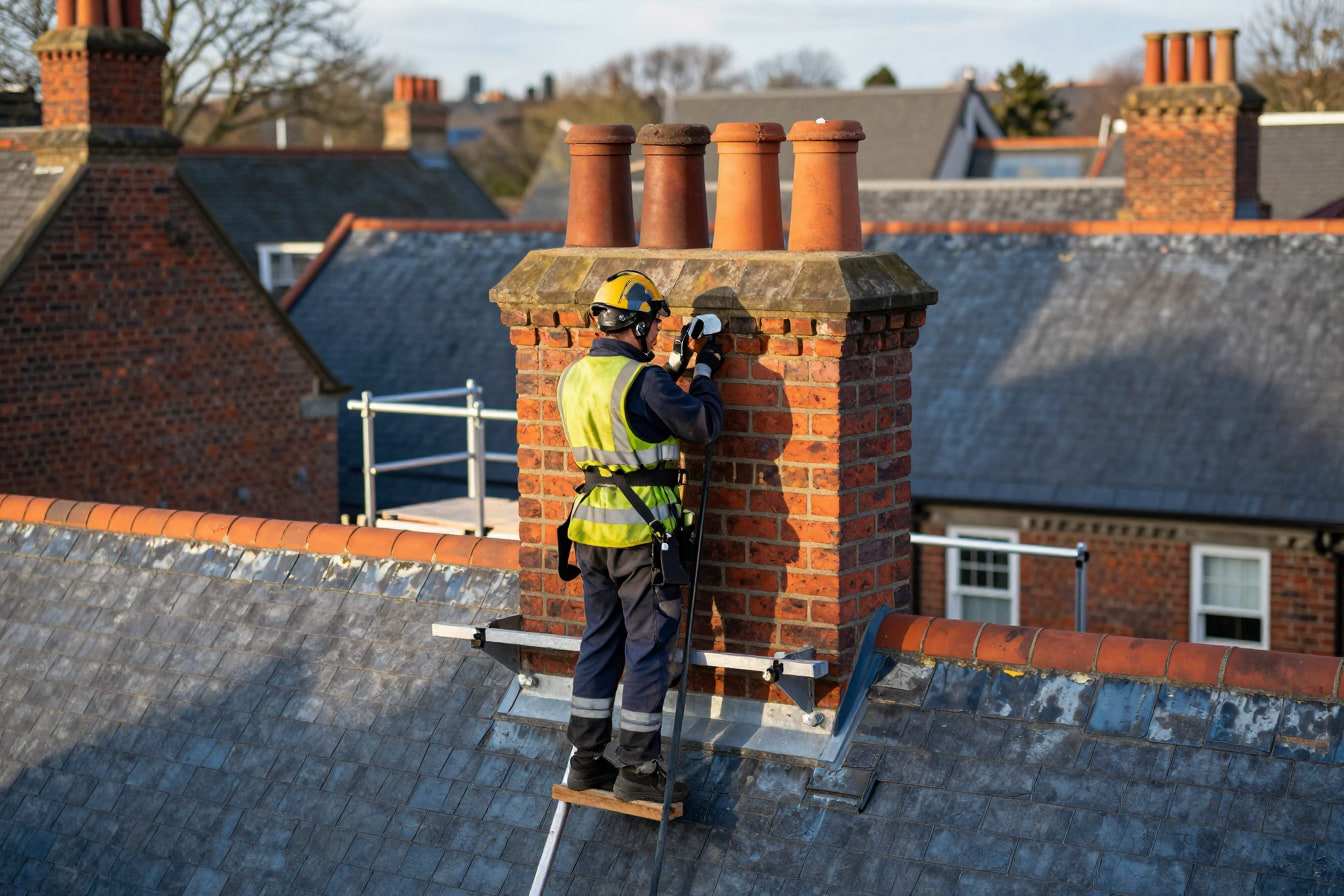
That is why we start with a drone survey. We photograph the top of the stack, the flaunching and the flashings from the air, show you exactly what is wrong and only put a scaffold up when there is work to do.
On terraces and semis, the stack is often shared with next door. It is worth talking to your neighbour early, since it usually makes sense to repair the whole stack in one go.
How much do chimney repairs cost in Cambridge?
Checkatrade’s 2026 chimney guides put repointing at about £750 on average, from around £300 for a small chimney on a low roof to about £1,000 for a mid-ridge stack that needs scaffold over the ridge. A flashing patch costs about £250 without scaffold, and replacing the flashing on all four sides £450–£600, or £800–£1,200 with scaffold. Partial rebuilds run at £600–£1,000, a rebuild above the roofline at £1,000–£3,500, and taking a stack down about £260–£340 per metre.
What moves the price: the height of the stack and how it is reached, the number of pots and flues, how far the brickwork has eroded, and whether matching bricks and pots can be salvaged.
Our chimney repair process
- Drone check: photos of the stack, pots, flaunching and flashings, plus a look at the chimney breast inside.
- Written quote with photos: what is wrong, what we recommend and the price, including any scaffold.
- Access and repair: scaffold or roof ladders, then the repair, using matched materials.
- Hand over: photos of the finished chimney and our 5-year warranty on the repair in writing.
| Job | Typical price | Typical time |
|---|---|---|
| Repoint a small chimney on a low roof | about £300 | — |
| Repoint a mid-ridge chimney (scaffold included) | about £1,000 | — |
| Patch repair to chimney flashing (no scaffold) | about £250 | 4–8 hours |
| Replace flashing on all four sides | £450–£600 (no scaffold); £800–£1,200 with scaffold | — |
| Partial chimney rebuild | £600–£1,000 | — |
| Rebuild a stack above the roofline | £1,000–£3,500 | — |
| Take down a redundant stack | £260–£340 per metre | — |
Guide prices from Checkatrade's 2026 chimney repointing and chimney flashing cost guides, excluding VAT. Where a high-level chimney scaffold is needed and not stated as included, allow about £500–£820 a week. We check the chimney by drone and fix the price in writing before any scaffold goes up. Get your exact price.
Signs your chimney needs repair
- Damp patches or staining on the chimney breast or the ceiling beside it
- Crumbling or missing mortar between the bricks
- Cracked flaunching, or pots that look loose or tilted
- Lead flashing lifting, split or pulled away from the brickwork
- Bits of mortar or brick in the gutter or on the roof
- A stack that visibly leans
- Water or debris coming down an unused fireplace