Key takeaways
- Typical lifespans: torch-on felt 15–20 years, GRP 25–30 years, EPDM rubber 30–50 years, mastic asphalt 20–30 years (Checkatrade, 2026).
- Ponding water, poor falls, blocked outlets, heat, frost and foot traffic are what cut most flat roofs short.
- Check the roof in spring and autumn, and clear outlets and gutters before October, Cambridge's wettest month.
- A local split or lifted edge on a sound deck is usually worth repairing; a roof that is blistered all over or soft underfoot is usually due for replacement.
- Replacing more than 50% of a flat roof triggers a Building Regulations insulation upgrade.
| Job | Typical price |
|---|---|
| Patch repair, felt or bitumen (per m², small areas) | £100–£140 per m² |
| Patch repair, EPDM rubber (per m², small areas) | £120–£170 per m² |
| Patch repair, GRP fibreglass (per m², small areas) | £130–£180 per m² |
| Flat roof repair (typical Cambridge job) | £584–£1,738 |
| Re-felt a flat garage roof | £1,000–£2,000 |
| New flat roof (typical Cambridge job) | £1,430–£2,988 |
Guide prices from Checkatrade's roof repair, re-felting and flat roof cost guides and its Cambridge roofing data (2025/26), excluding VAT and access equipment unless stated. Patch rates apply to areas up to about 3 m² and fall for larger areas. We confirm a fixed price in writing after a free survey. Get your exact price.
How long does a flat roof last? The honest answer is anywhere from about 15 to 50 years, depending mostly on what it is made of and how well it was laid. In Cambridge, where almost every terrace has a flat-roofed extension or dormer and many post-war homes have a flat-roofed garage, it is a question worth answering properly.
This guide gives the typical lifespan of each flat roof system, with sources, then explains what shortens a roof’s life, how to look after it through the year, the signs that it is failing and how to decide between repair and replacement.
How long does each type of flat roof last?
| Flat roof system | Typical lifespan | Source |
|---|---|---|
| Torch-on felt (bitumen) | 15–20 years (10–15 in Checkatrade’s GRP guide) | Checkatrade flat roof guide |
| GRP fibreglass | 25–30 years, with a recoat every 10–15 years | Checkatrade fibreglass guide |
| EPDM rubber | 30–50 years | Checkatrade rubber roofing guide |
| Mastic asphalt | 20–30 years | Checkatrade flat roof guide |
| Lead (to BS EN 12588, properly installed) | “Centuries, not decades” | Lead Sheet Advisory Service |
These are typical ranges, not guarantees. Two roofs made of the same material can have very different lives depending on the deck underneath, the falls, the detailing at the edges and how the roof is treated.
Felt flat roofs
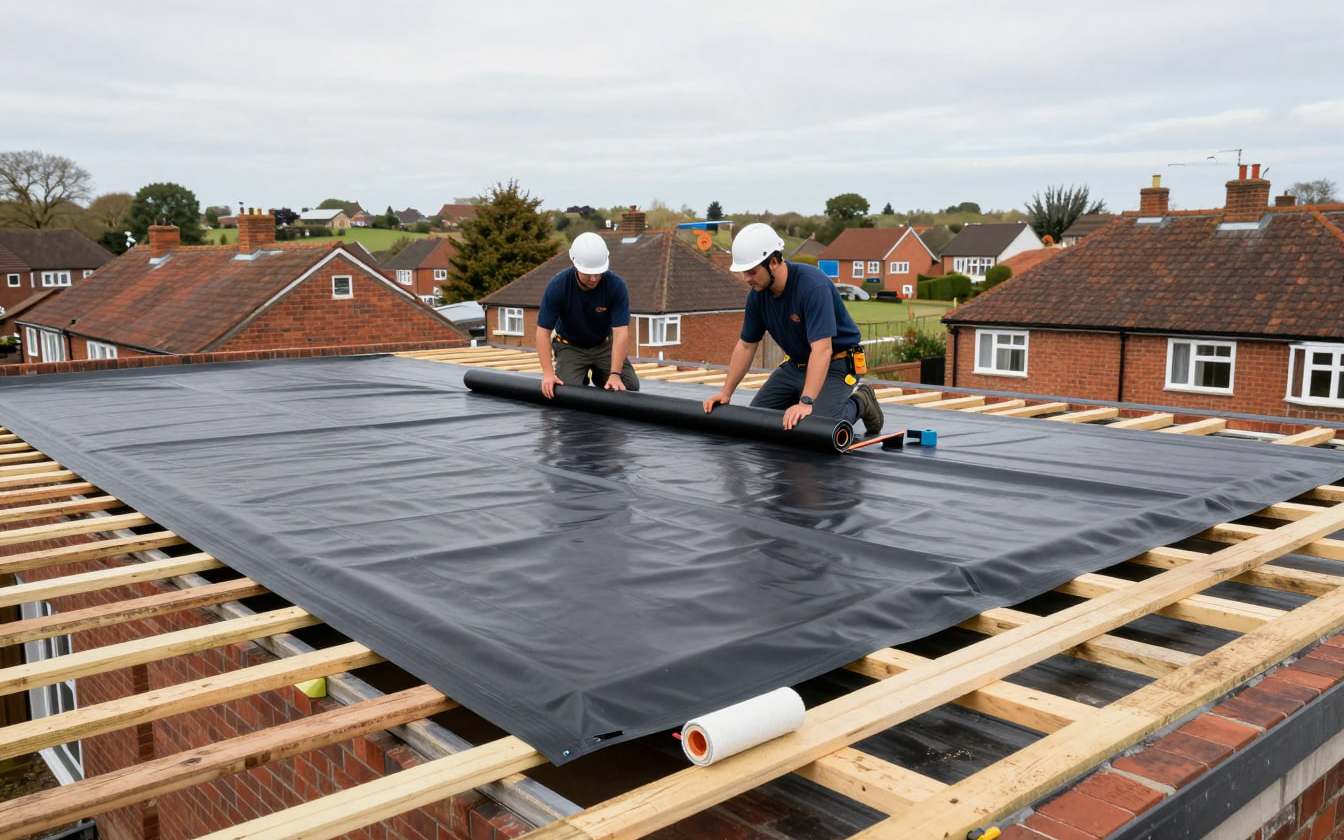
Felt is still the most common covering on older garages and extensions. A modern torch-on system, with a base layer and a mineral cap sheet, typically lasts 15–20 years. The older built-up felt roofs found on many 1960s and 70s garages often fail sooner, and once they start to blister and crack all over, patching rarely buys much time. If you are replacing one, our felt roofing page covers the modern options.
EPDM and GRP roofs
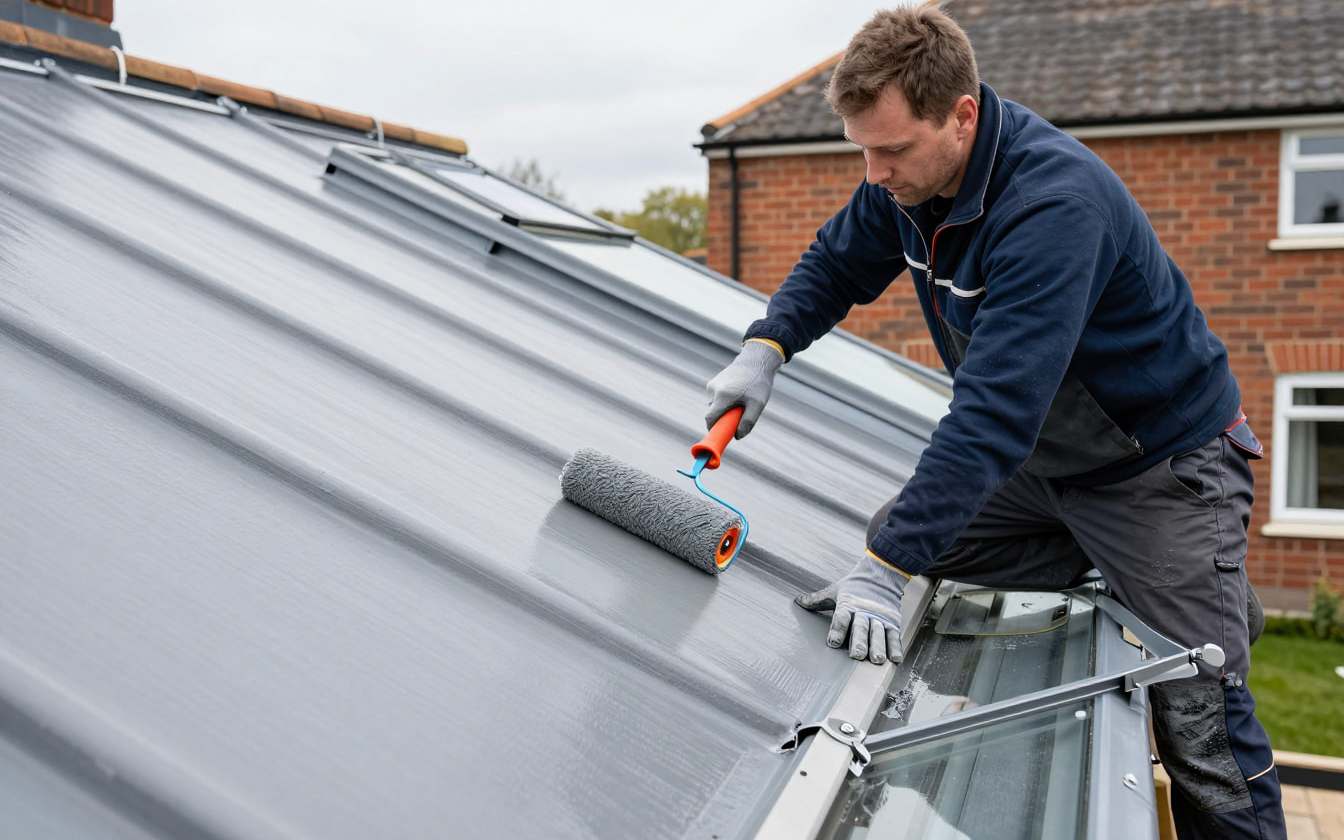
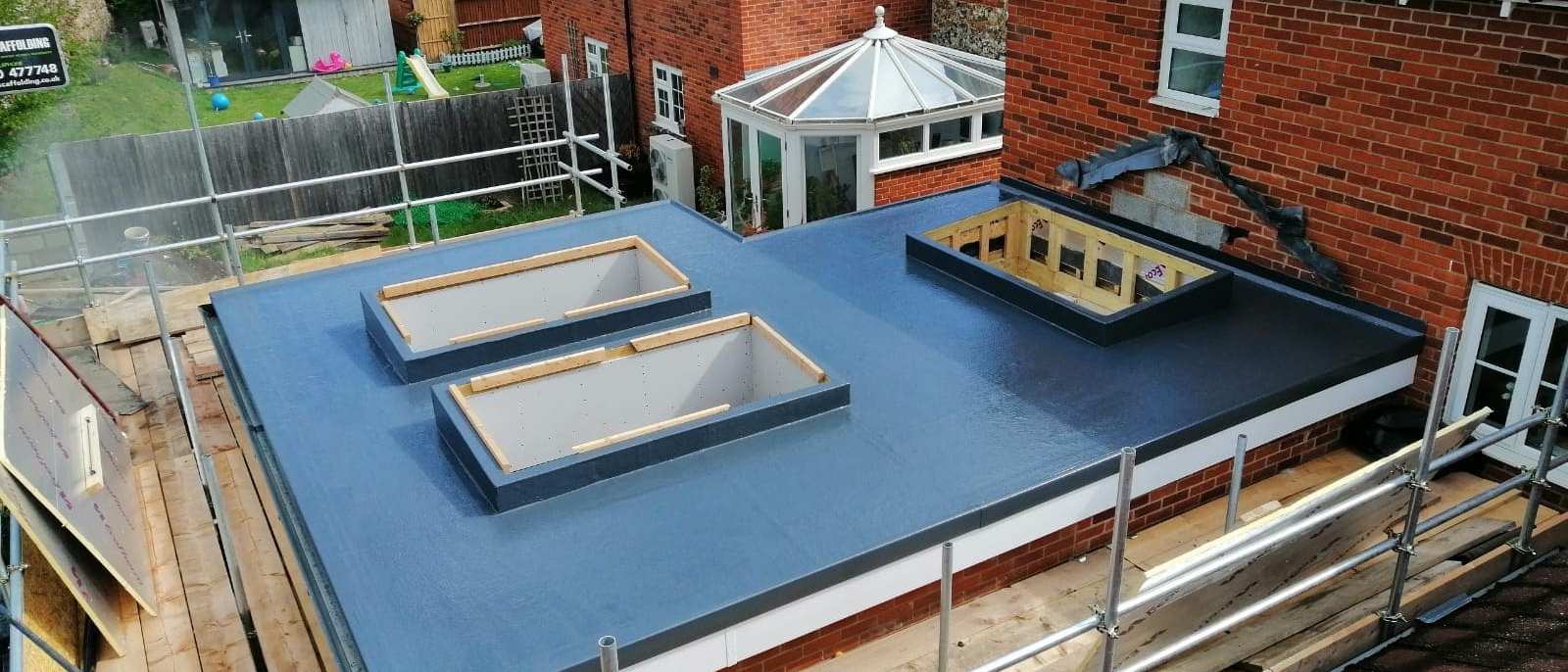
EPDM rubber is the longest-lasting of the common domestic systems, at 30–50 years. GRP fibreglass follows at 25–30 years, as long as the topcoat is renewed every 10–15 years. Both last far longer than felt, which is why they are the usual choice when an old felt roof is replaced. Our EPDM vs GRP vs felt comparison sets out the differences.
How can you tell how old your flat roof is?
Many homeowners in Cambridge inherit a flat roof with no idea when it was laid. A few clues help:
- Paperwork. A guarantee certificate, a building control completion certificate or a competent person scheme certificate will usually carry a date. Ask your conveyancer to check the sale pack if you bought the house recently.
- The covering itself. Old built-up felt is often finished with loose stone chippings; modern torch-on felt has a bonded mineral cap sheet; EPDM is a smooth black rubber sheet; GRP is a hard, smooth coating with a coloured topcoat.
- The neighbours. On terraces and estates, extensions were often built or re-roofed at the same time. If next door’s matching roof was replaced recently, ask how old theirs was.
- The edges. Heavily weathered timber fascias, old metal drip edges and patched upstands are signs of an older roof, whatever the surface looks like.
If you cannot tell, a roofer can usually judge the age and condition within a few minutes on site. On a free survey we photograph the roof, including the edges and outlets you cannot see from the ground, so you have a clear picture before deciding anything.
How long does a flat roof repair last?
A good repair on a sound roof can last as long as the roof around it. Patching a puncture or re-fixing a lifted trim on a ten-year-old EPDM roof, for example, should not shorten its life. A patch on a felt roof that is cracked everywhere is different: it stops that leak, but the next one is rarely far away. That is why we explain the condition of the whole roof alongside the repair price, and why every repair we carry out comes with our 5-year warranty.
What shortens the life of a flat roof?
Most flat roofs that fail early do so for one of a handful of reasons. Almost none of them are about the material itself.
Ponding and poor falls
A flat roof is never truly flat: it should have a gentle fall towards the outlets. The Confederation of Roofing Contractors says all flat roofs will have some ponding, but water still standing weeks after rain should be reported to your roofer. Persistent puddles add weight, speed up wear on the surface and find any weakness at joins and edges.
Heat and sunlight
Cambridge recorded the UK’s then-highest temperature, 38.7 °C, at the Botanic Garden in July 2019, and the Met Office named 2025 the UK’s warmest and sunniest year on record. Strong sun dries out bitumen felt, which then crazes, blisters and cracks. EPDM copes better because it stays flexible as it expands and contracts.
Frost and freeze–thaw
The Met Office’s 1991–2020 averages for its Cambridge NIAB station show about 40 days of air frost a year, with roughly nine in each of December, January and February. Water that gets into a small crack freezes, expands and opens it further. Checkatrade notes that GRP can crack over time in very cold conditions because it is less flexible than EPDM.
Blocked outlets and gutters
Leaves, moss and silt in a flat roof outlet stop water draining away, so it backs up across the roof and over the upstands. Overhanging trees make this much worse. Clearing outlets and gutters each autumn is the cheapest maintenance there is, and our roof and gutter cleaning service can do it for you.
Foot traffic and impact
EPDM can be punctured by sharp objects, and felt softens in hot weather. Ladders, window cleaners, satellite dishes and air-conditioning units all take their toll. If you need regular access, ask for a walkway or a GRP finish.
Poor detailing and condensation
Most leaks start where the roof meets something else: the house wall, a rooflight, a soil pipe or the edge trim. Upstands that are too low, flashings that have come loose and trims that have lifted all let water in. From below, condensation in an old cold roof can rot the deck while the covering looks fine. Our warm roof vs cold roof guide explains why.
How do you look after a flat roof through the year?
| Season | What to check | Why it matters |
|---|---|---|
| Spring (March–May) | Splits, cracks and lifted edges; flashings where the roof meets the wall; debris in outlets | Winter frost opens small defects |
| Summer (June–August) | Blistering or crazing on felt; seals around rooflights; where water sits after a downpour | Heat and strong sun age coverings fastest |
| Autumn (September–November) | Clear leaves from outlets, gutters and downpipes; cut back overhanging branches; book an inspection | October is Cambridge’s wettest month, at about 59 mm on average |
| Winter (December–February) | Ceilings inside after storms and thaws; edges and trims after high winds | Most frosts and storms fall in these months |
Do these checks from a ladder at the roof edge or from an upstairs window. The HSE says almost one in five deaths in construction work involve roof work, and all roofs should be treated as fragile until a competent person has confirmed otherwise. Never stand on a rooflight or dome, and leave anything that needs you on the roof to a roofer.
What are the signs a flat roof is failing?
- Water stains or damp patches on the ceiling below the roof
- Puddles that are still there long after the rain has stopped
- Blisters, bubbles, crazing or cracks in a felt surface
- Splits or lifting at the edges, upstands or around rooflights
- A soft or spongy feel underfoot, which usually means a wet or rotten deck
- Mineral chippings washing into the gutter, or moss and plants taking hold
- Drips on cold mornings when it has not rained, a classic sign of condensation
- A felt roof that is 15 or more years old
One sign on its own is not necessarily a disaster. Several at once usually mean the roof is near the end of its life. If water is already coming in, our roof leak repairs page explains how we trace and fix it.
Should you repair or replace a flat roof?
Repair usually makes sense when the deck is sound, the problem is local and the roof is well within its expected life. A split, a puncture, a lifted trim or a failed upstand can normally be put right for a fraction of the cost of a new roof. Checkatrade’s Cambridge data puts a typical flat roof repair at £584 to £1,738, with an average of about £1,002.
Replacement usually makes more sense when:
- the covering is blistered or cracked across most of the roof
- the deck is soft, sagging or rotten
- the roof keeps leaking in new places after each repair
- it is already near the end of its typical lifespan
A typical new flat roof in Cambridge costs £1,430 to £2,988, with an average of about £2,059, in Checkatrade’s local data. Remember that replacing more than 50% of a flat roof counts as renovation under Approved Document L, so the insulation should be upgraded at the same time, to 0.16 W/m²K where feasible. Our flat roof replacement cost guide explains every line of a quote.
When we survey a flat roof, we usually give you both options in writing, with photos, so you can see why we recommend one over the other.
Talk to a local roofer
Roofing Cambridge repairs and replaces flat roofs across Cambridge and the surrounding villages, from single garages to rear extensions and dormers. We offer a free survey by ladder or drone and a detailed written quote, and we will tell you honestly if a repair is all your roof needs.
Repairs come with our 5-year warranty and new roof installations with our 10-year insurance guarantee. Call 01223 902596 (Monday to Friday, 8am to 5pm) or request a free quote.
Sources
- Checkatrade: Flat roof replacement costs
- Checkatrade: Rubber (EPDM) roofing cost guide
- Checkatrade: Fibreglass (GRP) roof cost guide
- Checkatrade: Roof repair cost guide
- Checkatrade: Roofers in Cambridge, local prices
- Lead Sheet Advisory Service: About lead sheet
- Confederation of Roofing Contractors: Frequently asked questions
- Met Office: Cambridge NIAB climate averages 1991–2020
- HSE: Roof work
- Approved Document L, Volume 1: Dwellings (2021 edition incorporating 2023 amendments)
Figures were checked on 1 October 2026. Published prices are guides only and usually exclude VAT; we always confirm a fixed price in writing after a free survey.